As others have observed, the coverage of the UHC CEO killing and Luigi Mangione himself has had a not-so-subtle agenda. I can’t say I’ve kept up with it all, but I would like to discuss with you one of the articles I did read:
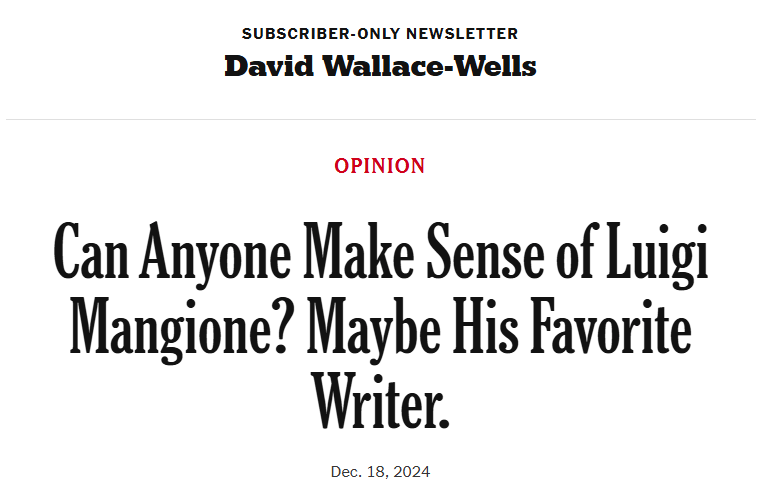
Here is an un-paywalled link to the article if you want to read it.
In this article, NYT opinion writer David Wallace-Wells talks with writer Tim Urban, whose work Luigi Mangione has publicly raved about, to hopefully gain some insight into the ideology (or lack thereof) behind the UHC CEO assassination.
Let me start by saying I don’t know a thing about David Wallace-Wells or Tim Urban—or Luigi Mangione, for that matter. I’m not trying to pass judgment on their other work, and I apologize if I misrepresent either of their views.
In the first section of the interview, Wallace-Wells and Urban discuss Mangione’s mental well-being. To their credit, they (really Wallace-Wells) acknowledge it as mere speculation. But that doesn’t stop them from, well, speculating:
David Wallace-Wells: When you saw that the alleged shooter was a big admirer of yours, what was your reaction?
Tim Urban: Honestly, confusion and sadness. Confusion about how someone who really likes my stuff could also be a person who does this.
If I imagine the Venn diagram circles of “people who not only like my stuff but evangelize about it” and “those who not just support political assassination but do it themselves” … if he is in fact guilty, he might be the only person in the overlap. And what that tells me is that, most likely, he had a really bad mental health break of some kind.
I am sick and tired of mental health being used to dismiss (with “compassion”) the possibility that the people who commit violent crimes may be, to some degree, rational actors, or at least as rational as the rest of us. Blaming mental illness could be somewhat helpful if one actually cared to look into what might be causing said illness, but in this case it’s about as helpful as blaming possession by demonic forces.
It also gives the impression of isolation. People with mental illness are different from others, and they act alone. They are each one-off, with one-off motivations and a one-off disregard for normality.
Explaining away something that challenges you means you not only have reason to avoid looking into it, but reason to pretend that there’s nothing to be found in doing so, anyway. If we allow Luigi Mangione to be not completely unhinged and understand his actions as being caused by something that affects other people, we are cornered into letting him truly be one of us, and then we’ll have really started some shit. His biography already establishes him an unusually educated, well-off, and frankly normal criminal, so Urban is scrambling to find something that could be wrong with him so as to make him different.
After some back and forth on the topic, they reach a conclusion that is…trash:
Tim Urban: That’s the other thing. It’s not even that Mangione was in better mental health than some other mass shooters as much as he was accepted by society. He was at the top of society in every way. He hasn’t been kicked to the outskirts.
David Wallace-Wells: He wasn’t beaten down, resentful, full of grievance — at least from what we know.
Tim Urban: Or deeply troubled, at least on the surface. It seems like he’s got a ton of friends, and it seems like he was a happy guy. Now, there’s the story about his back, and maybe chronic pain can drive someone really mad. But there’s not really an obvious story here, and so all we’re doing is kind of making them up.
That’s very insightful of you, Tim, but then why on earth did you do any of that? What was the point of trying to pull together a story, and why did you want it to be one of mental illness? Also, back pain is probably the most relatable medical condition a murderer could have, so this just isn’t a good look.
The interview rolls on, and Urban gets to what I really want to talk about: his defense of liberalism and his categories of “high-rung” and “low-rung” people. Let’s start with the latter—no pun intended.
David Wallace-Wells: … [Mangione] was not really a member of either the left fringe or the right fringe, but something you might call a new internet centrism. Some people use the word “heterodox.” How do you see the boundaries of that community, which you’re also a part of?
Urban: I would describe it as “high rung.” … I think of it in terms of a ladder. And up in the high rungs you’re looking for truth, and you’re not being tribal about it. And then the low rungs, it becomes this religious thing about your beliefs.
But when I say the people he was following were high-rung, I don’t mean that in some elitist way. To me, it means that these are people who don’t identify with their beliefs. They have strong beliefs, but the strength of their beliefs is pretty well tied to actual things they know about, and they don’t B.S. often. They’re humble. They treat their ideas like science experiments. You find this in a lot of the mainstream podcast people he seems to have admired. It’s people who have the basic message, free speech is good and discourse is good, and the typical style of radical politics is not productive.
What’s striking is that the people who are now celebrating him are the exact opposite people. They embody the low-rung, tribal mentality, where politics is a black-and-white war of good versus evil, where you dehumanize your enemies, where you identify so strongly with your political beliefs that any challenge to them feels like literal violence. This is the mind-set that leads people to celebrate political violence.
First of all, for anyone out there trying to not be accused of elitism, do not make ladders your allegory of choice.
I believe this whole ladder thing is something Urban has discussed in other places, so feel free to look into that if you want. I won’t be. Let’s put a pin in this and move to what Urban says about liberalism with regard to his book, which, according to the article, Mangione thought would “go down in history as the most important philosophical text of the early 21st century.”
Tim Urban: If I had to sum up the essence of my book, it’s a reminder of why liberalism is good . . . I think of it as a house that we’re all living in. Inside the house you have progressives and conservatives and you have far right and far left, and you have centrists and you have libertarians, and you’ve got all kinds of people and they’re sitting there arguing, but we all agree the house is good. But the house isn’t in perfect condition — this door isn’t working the way it’s supposed to, the heating isn’t working, let’s fix it. And some people argue: That’s not how you fix the house, or it’s working fine, or it’s not working fine for me. This is what’s going on inside the house, and that’s great — that’s liberalism.
[…]
The point of the book isn’t that you should never be mad at the health care industry — it’s that the house’s liberal nonviolent tools have historically been the most effective way to fix things. Granted, I’m sure people who hate the health industry are saying, “Where’s the change? We’ve been trying and it’s still awful.” And that may be true. But when you use political violence, what you’re doing is you’re trying to fix something in the house while smashing through one of the house’s support beams. And if you keep doing that, now someone else will assassinate someone on your side, and before you know it, it’s the road to hell.
And I don’t think he misunderstood that. He was holding book clubs about the book, and he seems like a smart person. I can’t imagine he didn’t understand the message. So then I’m like, how do you go from there to doing something that is so distinctly illiberal?
[…]
David Wallace-Wells: But if we’re taking this seriously as an ideological act, one way of explaining it would be that this is someone who has concluded that the house is broken and cannot be fixed from within.
Tim Urban: That is a radical position that I don’t agree with and I don’t think history supports. The amazing thing about liberalism is that it enables improvement over time with nonviolent means, and as flawed as it is, the alternative is worse.
So we get the picture. It seems that those high-rung people are those whose defining characteristic is that they abide by liberal ideals and methods, and low-rung people are the ones who get so attached to their (unjustified) beliefs that they’re willing to take a swing at the infrastructure that makes this whole thing run, or so Urban thinks.
The Mangione question is exactly what Urban asks. How did this guy, a follower of the high-rung crowd, come to behave in such a markedly low-rung way? It is the same question implied in their discussion of Mangione’s social status. He is wealthy, white, young, a UPenn grad, etc.—why isn’t he acting like it?
Fanon Weighs In
How does Urban ultimately “make sense of” Mangione? Mangione is, in most respects, a well-off and well-adjusted young person who snapped for reasons unknown and decided to commit a pointless and impulsive act of political violence which garnered the attention of the “low-rung” internet users now applauding him.
This is, at best, a useless “analysis.” It does nothing to imagine Mangione’s motivations. It does nothing to understand his following, it only dismisses it as unintelligent and “tribalistic.” How can Urban call himself “high-rung” when he can’t set aside his agenda to actually think?
Let’s see if Friend of the Blog Frantz Fanon can help us come up with better theory of Luigi Mangione. “Concerning Violence” is a text that I am certainly not an authority on, but it has been stuck in my head for years now with no place to go, and I wanted an excuse to revisit it. There are free versions of it everywhere; here’s one, and here is a study guide I found for the TL;DR.
In “Concerning Violence,” Fanon discusses both colonial and capitalist contexts. There are some differences between the two, but most of his ideas on decolonization still apply, even if they manifest differently.
Firstly, Fanon says there are two important groups of people, or two “species,” as he puts it, one on top of the other. There are the colonizers and the colonized, or the bourgeoisie and the proletariat, and that’s it. There are no real shades of grey in the colonial or the capitalist world. Sure, there are those colonized who are in with the colonizers, and vice versa, but they remain fundamentally the colonized or the colonizer, respectively.
This strict binary holds water in our case. Tim Urban failed to explain was why Luigi Mangione has become popular with a diverse group of people typically divided along political lines, as well as by gender, race, and education. However, Fanon gives us insight into why people don’t see him based on his membership to these various sub-classes, for if Fanon is right, the class divide is in some sense more fundamental than these, and people are sensitive to that fact. Again, there are only two options, so if he is in opposition to the ultra-wealthy, CEO class, then he’s one of us.
Let’s talk about violence.
Fanon says that the colonial world is born from violence. The colonizer doesn’t merely control the colonized through violent means, but in a very real way creates and maintains the existence of the colonized through constant physical and psychological violence: “For it is the settler who has brought the native into existence and who perpetuates his existence. The settler owes the fact of his very existence, that is to say, his property, to the colonial system.” It is for this reason that Fanon believes colonialism is an infringement on humanity itself, and that decolonization is a collective reclamation of humanity.
This kind of world is in every possible way built to suppress the colonized, or the “native” as Fanon usually refers to her. Fanon says that “from birth it is clear to [the native] that this narrow world, strewn with prohibitions, can only be called in question by absolute violence.”
He defines this “calling into question” quite simply: “‘The last shall be first and the first last.’ Decolonization is the putting into practice of this sentence.” Decolonization is not so much a process as it is a moment in which the order of society is reversed. Importantly, it is not a moment of egalitarian civil discourse or liberal “house-maintenance.”
Fanon says that “[Decolonization] cannot come as a result of magical practices, nor of a natural shock, nor of a friendly understanding.” But why? Why exactly can’t they talk it out? I think we get at least two good answers from Fanon.
Firstly, he writes, “Decolonization is the meeting of two forces, opposed to each other by their very nature … Their first encounter was marked by violence and their existence together—that is to say the exploitation of the native by the settler—was carried on by dint of a great array of bayonets and cannons.” Neither of these forces is in a position to be pacifist. If one is to undo the system, it must violate the order it has created, meaning it will violate the power and protection of the oppressors and violate the submission of the oppressed.
Secondly, Fanon calls into question “universal” values that we can all come around to, for he says these are also weaponized to defend the order. Appealing to them does nothing to disrupt, it only reinforces.
“During the period of decolonization, the native’s reason is appealed to. He is offered definite values, he is told frequently that decolonization need not mean regression, and that he must put his trust in qualities which are well-tried, solid and highly esteemed. But it so happens that when the native hears a speech about Western culture he pulls out his knife—or at least he makes sure it is within reach.”
“The natives’ challenge to the colonial world is not a rational confrontation of points of view. It is not a treatise on the universal, but the untidy affirmation of an original idea propounded as an absolute.”
The native’s refusal to uphold so-called universal values is then used to paint them as immoral.
“The native is declared insensible to ethics; he represents not only the absence of values, but also the negation of values. He is, let us dare to admit, the enemy of values.”
Sounds a bit low-rung to me…
Something I think is worth noting is that Fanon says the first of these values to disappear in the mind of the colonized is the idea of the individual.
“The colonialist bourgeoisie had hammered into the native’s mind the idea of a society of individuals where each person shuts himself up in his own subjectivity, and whose only wealth is individual thought … Brother, sister, friend—these are words outlawed by the colonialist bourgeoisie“
First, throwback to mental health. Second, this speaks to all the “issues” we are so polarized on and how no one could possibly understand those on the other side, identity politics, and echo chambers. We want to defend what makes us us, but these things are often used to distract us from uniting around what is genuinely universal.
Another claim in the Fanon is that all colonized people share in the desire for a violent upturning of the colonial order: “The need for this change exists in its crude state, impetuous and compelling, in the consciousness and in the lives of the men and women who are colonized.” There is clearly something about Luigi Mangione that is…compelling, to put it mildly. I think Fanon would say that what makes him especially thirst trap-able (sorry to put those words in your mouth, Frantz) is that he has done what a lot of us maybe want to do or to at least see someone else do. That what people have found in him is an expression of their own desire for retribution, to punish whoever is at the top for stepping on however many people they had to on the way there. Or perhaps more precisely we want to punish them for the entitlement and callousness necessary to undertake such an ascent. The complete reversal of order, where a CEO is on the bottom and a comparatively middle-class person is on the top, is exactly the retribution we’re craving.
So what does Fanon make of Luigi Mangione? We might understand UnitedHealthcare as a company that kills because it and its greedy CEO put money before people’s medical needs. Exactly whose place Mangione took—UHC or Brian Thompson—is an interesting question, but he disrupted the order. And we might think he is perfectly justified in doing so. Private healthcare companies crush working people, preying on their suffering to fatten up rich executives. It was in fact inevitable that this sort of thing would happen, just as it was inevitable that people would rally around him. In the moment of killing Brian Thompson, Mangione realized his own humanity, because he didn’t kill an innocent father or husband; he killed someone who has made him less than human, and who built his fortune off of violence against people like him.
If you’ve made it here, humor me with this last paragraph before I wrap up:
I’m not really into teleological views of nature, or the idea that everything has a natural objective to its existence. But if I were to entertain such a view, I would think that the natural goal (telos) of companies is to make money. I don’t believe that companies are just groups of people; companies are themselves entities. They rely on people but they do not operate or possess the characteristics of people. And on this view, I wonder whether companies would be, by their nature, opposed to the nature of people. The objective of profit lends itself to a “healthy free market” for about two seconds before it becomes clear that the most profitable markets to conquer are not ones that benefit people. You make the most money when people are scared, hurt, and have no alternatives. I think humans are in more opposition to companies and to capital than to other humans, but perhaps Fanon is right that the only way to do away with those is to self-destruct the order it has created and thrives on.
Who’s Right?
I think it is fair to say Fanon’s ideas have considerable explanatory and predictive power—more than Tim Urban’s, at least—and if it is true that what Luigi Mangione did was akin to an act of decolonization, we might find that he was justified. But is it fair to compare current America to a colonial setting like this? Are we living in a world of violence? And who exactly are the “colonizers” today, if they exist? Are they people? Are they corporations? Are they better understood as something more abstract, like the market, or even greed itself? And can our problems be overcome through the tools of liberalism, like Urban thinks they can? Or have those tools been, at best, co-opted by those who—not to be dramatic—seek to destroy us? To make us less than human?
I don’t have an answer to this. I don’t even have an answer as to whether Fanon or Urban is right or wrong about how change works, or whether such a universal theory of change is reasonable to begin with. But how we might begin to evaluate these questions is to ask ourselves, what violence is being done to us right now? In what ways we have been made to be less than human? Where are we being degraded? Where are we being manipulated into doing things that are bad for us? And who or what is telling us that it’s either okay or a regrettable work in progress? I think you’ll find that it’s not just healthcare. It’s social media, it’s ads, it’s our food, it’s the police, it’s bureaucracy, it’s education. And yet, we are told that we can make it out of these things through merit and that we must remain in support of the systems that continually violate us. That’s not just a broken support beam in our house of liberalism:
“In capitalist societies the educational system, whether lay or clerical, the structure of moral reflexes handed down from father to son, the exemplary honesty of workers who are given a medal after fifty years of good and loyal service, and the affection which springs from harmonious relations and good behavior—all these aesthetic expressions of respect for the established order serve to create around the exploited person an atmosphere of submission and of inhibition which lightens the task of policing considerably.”
Might we become something else if we believed we deserve better?
“[The native] knows that he is not an animal; and it is precisely at the moment he realizes his humanity that he begins to sharpen the weapons with which he will secure its victory.”
 Welcome to Neural Nirvana